Iron Infusions
Iron infusions, delivered to your door
Low iron is common — particularly for anyone whose iron stores have been hard to rebuild with tablets alone — and can leave you tired, foggy and run-down. Where a clinician confirms it is appropriate for you, an iron infusion delivers a full dose of iron straight into your bloodstream in a single short appointment to help replenish your iron stores.
VitalLine uses intravenous Ferinject (ferric carboxymaltose) — the same medicine and the same evidence base used across New Zealand primary care — and brings it to you, in the comfort of your own home, led by an experienced paramedic.
Ferinject is a prescription medicine, prescribed and administered only where clinically appropriate. See the important prescription medicine information.
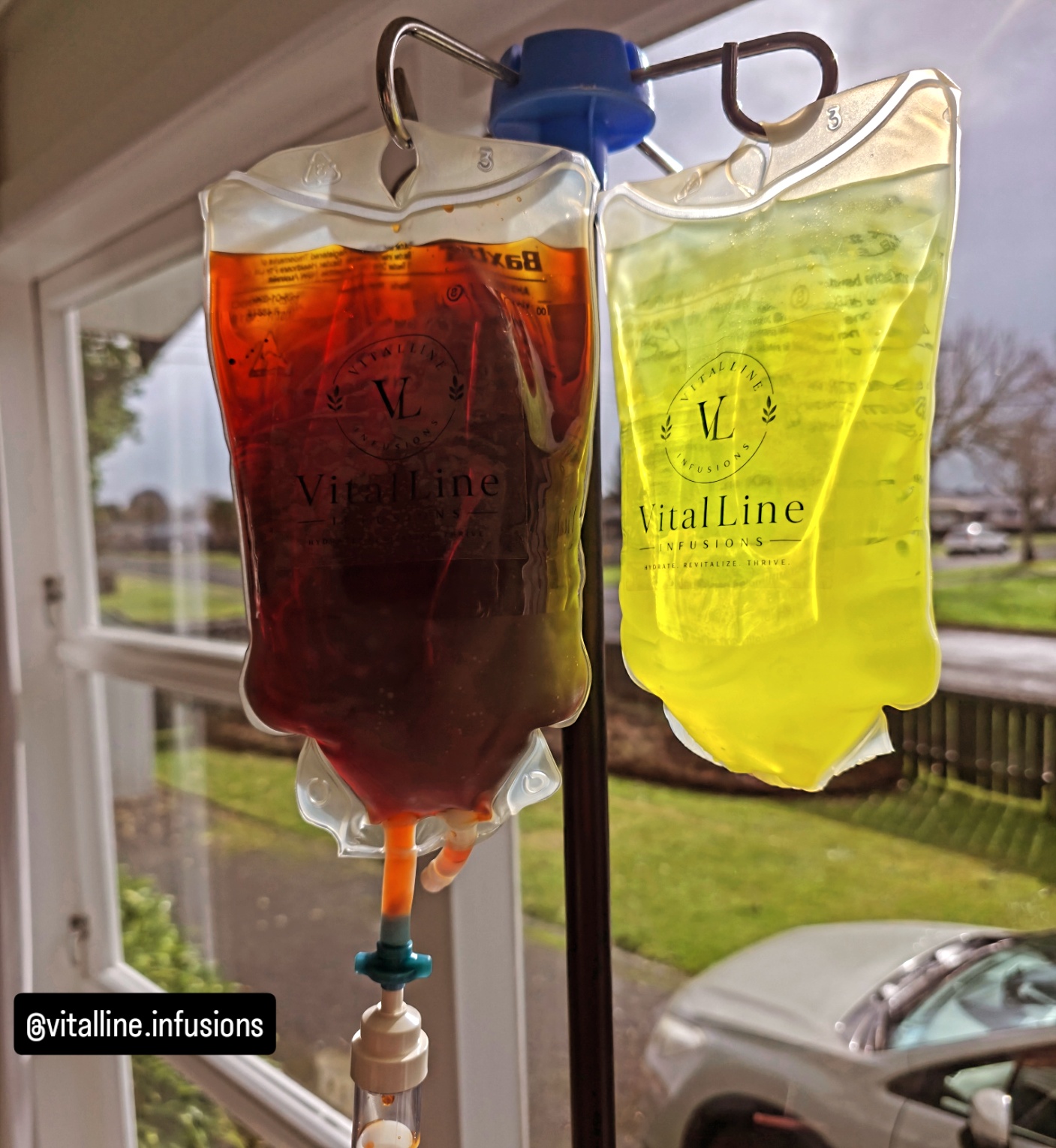
What to expect
How an iron infusion works with us
From your first screen to your follow-up, here's the journey — designed to be simple, safe and entirely at home.
Step 1
Clinical screening & blood tests
Every infusion starts with a clinical screen. We review your recent blood work — your ferritin and haemoglobin — along with your health history to confirm an iron infusion is suitable and safe for you, and whether you qualify for PHARMAC funding. Blood tests usually need to be within the last few weeks.
Step 2
Your prescription
Ferinject is a prescription medicine. If you meet the funding criteria, you can use a funded prescription from your own GP — or, for an additional fee, we can arrange the funded prescription for you. If you don't meet the criteria, we can arrange Ferinject privately.
Step 3
We collect your Ferinject
Once your prescription is sorted, your paramedic collects the Ferinject from the pharmacy ahead of your appointment — so everything is ready before we arrive at your door.
Step 4
The infusion, in the comfort of your home
Your paramedic delivers the infusion at home. The Ferinject is diluted and given through a small drip into a vein in your arm. The infusion itself takes around 15 minutes — no need to fast, just carry on with your usual day.
Step 5
Monitored throughout
You're monitored before, during and after your infusion for your comfort and safety, with a period of observation once it's complete. Anti-nausea medication may be provided if needed. Your paramedic talks you through what to expect at every step.
Step 6
Recheck & follow-up
Iron levels are usually rechecked around 2–3 weeks later to see how you've responded. Depending on the dose you need, a further infusion may be recommended — some people need more than one to fully restore their iron stores.
Funding & pricing
How funding works
In New Zealand, Ferinject is fully subsidised by PHARMAC for people who meet the Special Authority criteria. Whether or not you qualify, we can help — there are two paths, and your clinician confirms which one applies after reviewing your bloods.
If you meet the criteria
Funded
From $149
If you meet PHARMAC's Special Authority criteria, the Ferinject medicine itself is fully funded. You can use a funded prescription from your own GP — or, for an additional cost, we can arrange the funded prescription for you. Your in-home infusion with VitalLine is from $149, including monitoring throughout (an additional prescription cost may apply if we arrange it for you).
If you don't meet the criteria
Private
From $440
If you don't meet the funding criteria, we can arrange Ferinject privately at $240 per 500 mg vial plus a $200 administration fee. Depending on the dose calculated for your weight and iron level, some people need two vials (e.g. two 500 mg vials + administration = $680). The same in-home process and monitoring applies.
Important — prescription medicine information
Ferinject (ferric carboxymaltose 50 mg/mL injection) is a Prescription Medicine used to replenish iron when iron deficiency has been confirmed and oral iron is unsuitable or has not worked. It is funded by PHARMAC for people who meet the Special Authority criteria; otherwise charges apply. Ferinject has both benefits and risks, is not suitable for everyone, and must be prescribed and administered by a health professional. Do not use it if you are allergic to it or have iron overload. Tell your clinician about your medical history and medicines, and if you are pregnant or breastfeeding. Possible side effects include temporary low blood phosphate, nausea, headache, injection-site reactions and, rarely, allergic reactions. If you have side effects, talk to your doctor. Always read the Consumer Medicine Information and use as directed. Read the Ferinject Consumer Medicine Information or talk to your healthcare professional. Normal prescription and consultation charges may apply.
The official PHARMAC sources below set out exactly who qualifies for funded ferric carboxymaltose. Funding eligibility is always confirmed by a clinician after reviewing your recent blood work.
PHARMAC · Special Authority
How PHARMAC funds your iron infusion
Ferric carboxymaltose is fully subsidised by PHARMAC — but only when you meet the Special Authority criteria (number SA2394). In short: a diagnosis of iron deficiency or iron deficiency anaemia, with a serum ferritin at or below 20 µg/L (or 20–50 µg/L with raised CRP, or a qualifying chronic inflammatory disease), usually after oral iron has failed or isn't tolerated. This official PHARMAC document lists the exact criteria your clinician applies for.
PHARMAC · Access
Iron infusions in the community — widened access
From November 2024 PHARMAC widened funded access to community iron infusions, including for people with iron deficiency anaemia alongside chronic inflammatory disease (such as heart failure or chronic kidney disease). This page summarises who can now receive a subsidised infusion and the conditions that apply.
Ready to restore your iron?
Book a time and our paramedic will bring your iron infusion to you, at home. Every booking begins with clinical screening, so we can confirm it's right for you and whether you qualify for funding.
Book a SlotThe evidence
Trusted New Zealand research
These are the key New Zealand sources we practise by — shared for education, with a short summary of each and a link to the full article. Whether an iron infusion is right for you is always decided by a clinician after reviewing recent blood work and your health screening.
BPACNZ · Clinical guidance
Intravenous iron in the community
BPACNZ's prescribing guide explains why intravenous ferric carboxymaltose (Ferinject) has become the preferred parenteral iron option in New Zealand primary care. Because it is non-dextran based with very low immunogenic potential, a high dose can be replaced in a single short infusion — useful when oral iron has failed, isn't tolerated, or when rapid correction of iron deficiency anaemia is needed.
NZ Medical Journal · Review
IV iron infusion & newer non-dextran formulations
A New Zealand Medical Journal review (134(1534):118–127) of the modern non-dextran iron formulations — ferric carboxymaltose, iron sucrose, iron isomaltoside and ferumoxytol. It describes how a complete or near-complete iron replacement can now be given in a single 15–30 minute sitting with an improved safety and tolerability profile, and how infusions can be delivered safely in community settings rather than only in hospitals.
Medsafe · Datasheet
Ferinject (ferric carboxymaltose) datasheet
The official Medsafe data sheet for Ferinject — the medicine VitalLine uses for iron infusions. It sets out the 50 mg/mL strength, vial sizes (100 mg, 500 mg, 1,000 mg), dosing (up to 1,000 mg per session over ~15 minutes followed by 30 minutes of observation) and the full safety profile every clinician follows before treating you.
Medsafe · Safety
Risk of low phosphate after iron infusions
A Medsafe Prescriber Update reminder (December 2024) on hypophosphataemia — a known side effect of ferric carboxymaltose where blood phosphate can drop after an infusion. It explains the symptoms to watch for (bone pain, fatigue, weakness) and why your clinician considers risk factors and monitoring. This is exactly the kind of safety check built into our screening.
Medsafe · For you
Ferinject — patient information leaflet
The plain-language Consumer Medicine Information for Ferinject, written for patients rather than clinicians. A good place to start if you'd like to understand what an iron infusion involves, what to expect on the day, and the possible side effects — all in everyday language.
Links open external New Zealand sources (BPACNZ, Medsafe, the NZ Medical Journal and PHARMAC) and are provided for educational context. VitalLine Infusions does not control their content. All infusions are subject to clinical screening — iron infusion therapy depends on clinical suitability, recent blood work and screening, and funding eligibility is confirmed by a clinician.